BACKSTROKE: FROM SELLING HOURS TO SELLING OUTCOMES WITH RJ TALYOR
RJ Talyor explains how Backstroke uses AI to eliminate creative overhead and shift agencies from selling hours to outcomes.
TL;DR
AI is turning the agency model upside down, shifting the focus from selling hours to selling outcomes. Backstroke CEO RJ Talyor reveals how to ride the generative wave without losing the human touch.
INTRODUCTION
Welcome to the VentureStep podcast, where Dalton Anderson explores the intersection of entrepreneurship, industry trends, and the technology shaping our future. In this deep-dive episode, we explore a fundamental shift in the digital landscape: the transition from marketing agencies selling manual hours to delivering automated, high-performance outcomes. As AI begins to generate in seconds what once took teams a week to produce, the very definition of "creative work" is being rewritten.
Our guest, RJ Talyor, is a 2X founder and the CEO of Backstroke, bringing two decades of digital marketing expertise to the conversation. From his early leadership at ExactTarget (acquired by Salesforce) to founding the creative AI platform Pattern 89 (acquired by Shutterstock), RJ has been at the forefront of every major marketing tech wave. Now, at the helm of Backstroke, he is helping firms evolve their digital efforts by eliminating the overhead that traditionally bogs down creative production.
Throughout this 47-minute conversation, Dalton and RJ break down the decade-long evolution of ad bidding, the "interruption" of the creative process by LLMs, and the rise of hyper-personalized email marketing. They discuss the ethical and legal minefields of AI-generated models and why "strategy" is no longer just a buzzword—it is the only human differentiator left.
KEY TAKEAWAYS
- The digital marketing landscape has moved from human-run spreadsheets to automated bidding, and now to automated creative production.
- "Nano Banana" and similar generative models are enabling brands to replicate expensive photo shoots in seconds, altering backgrounds and outfits with near-perfect lighting.
- Backstroke’s competitive edge comes from a four-and-a-half-year proprietary data set tracking tens of thousands of email programs and consumer preferences.
- Modern agencies must shift from charging for production hours to charging for strategic "gigawatts of thought," as output becomes a commodity.
- Founder success requires extreme emotional resilience to manage the "highs and lows" of a startup, alongside a culture that embraces "AI-first" problem-solving.
FULL CONVERSATION
The 10-Year Evolution: From Data to Creative
Dalton: Welcome to the show, RJ. I’d like to jump right in and get your perspective on how the workflow has shifted over the last five years versus the last 18 months.
RJ: It’s been a wild ride. Around 2015, machine learning algorithms emerged that changed digital ad buying and bidding. Agencies used to make money managing spend on platforms like Meta and Google, but then those platforms released tools that automated what humans used to do on spreadsheets. Those folks then shifted their focus to optimizing creative instead of just cost-per-click.
RJ: In the last five years, specifically with GPT-3 going mainstream about three years ago, copywriters realized the machine could write for them. Creatives used to think their jobs were safe because they were the "photographers" or the "creators," but now LLMs and platforms like Nano Banana create content that is remarkably good and on-brand.
RJ: Differentiation now comes from strategy, taste, and brand positioning—things that are ultimately human. The adjustment in the last 10 years has been stark, and the insertion of AI into the creative process is accelerating faster than ever.
The agency landscape is shifting from selling hours to selling outcomes.
The "Nano Banana" Experiment and Ethical Shifts
Dalton: I actually did a demo of the "Nano Banana" model. It went viral on TikTok, and then Google actually changed the name because of it. I took models wearing tan shirts and jeans and used Pinterest clips to switch their outfits and backgrounds in 30 seconds. The results were more legit than I expected.
RJ: It’s remarkable. Thousands of dollars spent on photo shoots can be replaced by replicating a pose with different imagery. You can animate it and change backgrounds, but it brings up massive ethical and legal implications. For instance, in New York, there’s a law coming in June requiring disclosure if an image includes a generated human.
RJ: From a brand perspective, we can now do things more cheaply and with more inclusive model sets—different skin tones and body types—without paying for human models to be there. Small brands can now look as big as competitors with massive budgets. But there is a human consequence: photographers, models, and lighting crews are losing those jobs.
Dalton: We’re getting there on the video side too. In a year, it might be hard to tell what was filmed versus what was generated. How should people in these roles shift their skills?
RJ: Become an expert in the tools. Dive in and experiment. A photographer who knows Photoshop is valuable, but a photographer who knows Photoshop and generative tools has a trifecta. You can either ride the wave or watch it happen.
The wave's coming with or without you.
Inside Backstroke: Predictive Data and the "Brand Brain"
Dalton: Tell me about the waves Backstroke is making. You mentioned a proprietary data set that drives your AI assets differently than if I were just using a standard tool.
RJ: We started Backstroke a year and a half ago, but four and a half years ago, I started signing up for every email marketing program I could find—tens of thousands of them. We automated the process to understand what content, offers, fonts, and colors brands use at different times of the year.
RJ: We also build our own data set of consumer preferences. Someone in New York has different preferences than someone in Indianapolis. We use that to generate content that isn't just creative—it's predictive of performance.
Dalton: So if I contract with Backstroke, how does it work for my mailing list?
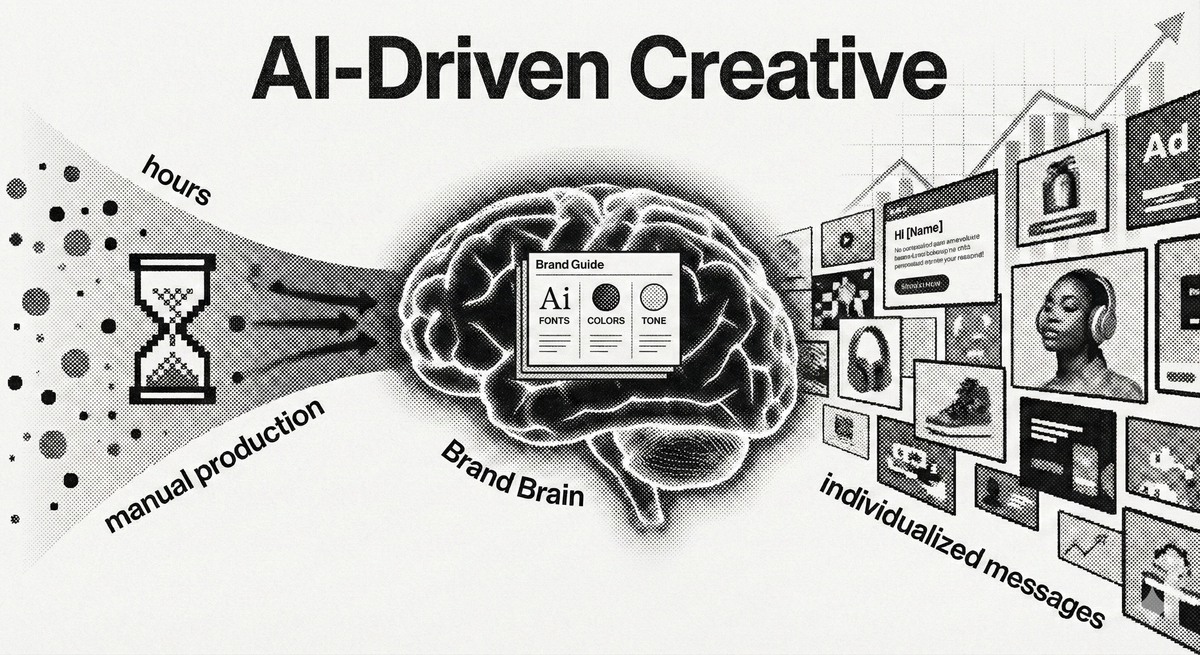
RJ: We connect to your messaging platform and profile your subscribers by demographic and performance. We ingest your past creative and brand standards to understand your "creative vibe". This allows us to provide predictive content generation tailored to individuals.
RJ: Eventually, we want to reach a point where all one million people on your list get a different message. The bottleneck today is trust—marketers are hesitant to send variants they haven't QA'd with human eyes. Solving that is our mission for the next two years.
We're using AI to identify patterns that humans are incapable of finding and we're using a massive data set that hasn't existed before.
Shifting from Hours to the "Gigawatt of Thought"
Dalton: So this "firm-based model" takes in their data and your proprietary data to provide better, faster marketing. It sounds like human-in-the-loop is still essential at this stage.
RJ: Exactly. Once we have the "brand brain" configured with your fonts, colors, and tone, it can create variants that are always on-brand. Humans then move from creating content to reviewing and strategizing.
RJ: This changes the agency business model. Agencies usually sell hours of production time, but strategy is often just "included" because it’s hard to quantify. Now, output is the byproduct. We have to be good at ideas and curation. We need to charge by the "gigawatt of thought" rather than by the hour.
Dalton: Legal is seeing the same thing. Instead of billing 30 minutes for a five-minute email, work is being billed by the case because AI can handle the research and verification.
RJ: I was at an executive retreat with 50 e-commerce leaders, and the number one topic was time efficiency. They weren't talking about getting rid of people; they were talking about putting time back into their teams. One executive even has a dashboard tracking hours saved by AI. They want people thinking, not doing mundane repetitive work like renaming files or cropping photos.
You as a human, like as a creative director or you as a content strategist, get to review content instead of creating the content.
Founder Lessons: People, Empathy, and Emotional Baseline
Dalton: That leads into having an "AI-first" culture. You have to work smarter.
RJ: It’s like being told to build a house. You can use a manual saw, or we can give you a nail gun and a chainsaw, but be careful because the chainsaw might cut your arm off. We are in that transitionary space where people are wary of the risks.
Dalton: RJ, you’ve done this several times—ExactTarget, Pattern 89, and now Backstroke. What are your key founder lessons?
RJ: First, people matter more than you think. I’ve built Backstroke with people I’ve worked with before because we have a shorthand and understand each other's quirks. I don't know how founders who meet at a hackathon make it work—it's like a work marriage.
RJ: Second, listen to the customer. What the market says about AI "eating everyone's lunch" is different from what’s happening in the trenches, where people are just trying to learn. We focus on accountability and empathy because we are changing people's livelihoods.
RJ: Finally, manage your emotions. Startups have extreme highs and lows. One day you think you’ll be worth billions, and the next you think you're doomed. You have to recognize those patterns in yourself to stay on target.
Dalton: That’s a great perspective. Highs and lows are part of the deal, but realizing they are temporary keeps you moving toward the long-term goal. RJ, thank you for joining us.
RJ: Thanks, Dalton. Check us out at backstroke.com.
I'm allowed to have that emotional response, but like, know that like... the target that we're on is still legitimate.
RESOURCES MENTIONED
- Backstroke
- ExactTarget (now Salesforce Marketing Cloud)
- Pattern 89 (acquired by Shutterstock)
- Salesforce
- Shutterstock
- Meta (Facebook)
- GPT-3
- TikTok
- Commerce Next
- Office Space (Movie)
- Cursor
INDEX OF CONCEPTS
RJ Talyor, Dalton Anderson, Backstroke, ExactTarget, Pattern 89, Salesforce, Shutterstock, Google, Meta, Facebook, GPT-3, Nano Banana, Pinterest, TikTok, New York Disclosure Law, Predictive Content, Brand Brain, Gigawatt of Thought, Commerce Next, Office Space, TPS Report, Cursor, SOC 2.



Comments ()